Where payment integrity architectures usually break
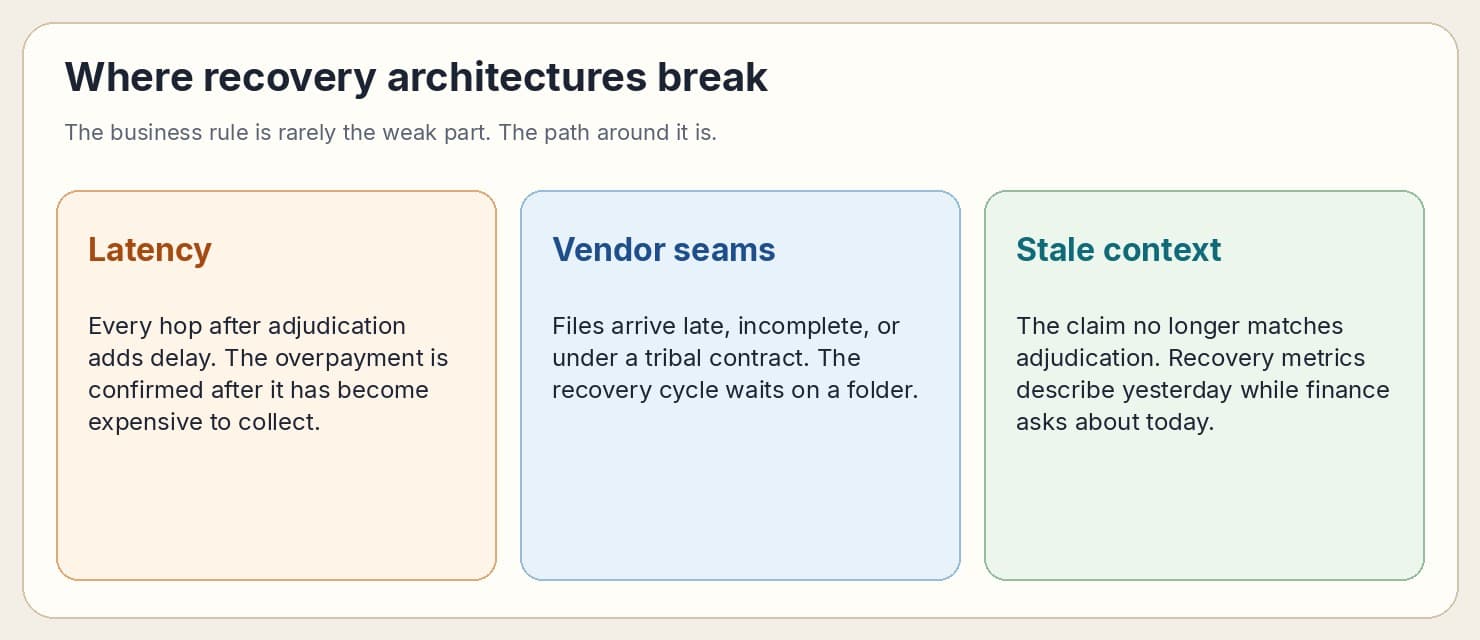
Post-pay recovery fails less from missing rules and more from latency, brittle vendor seams, and claims data that no longer matches adjudication reality.
- Payment Integrity
- Architecture
- Healthcare
Most payment integrity programs start with the right instinct: catch overpayments, credit-balance issues, and subrogation opportunities before leakage compounds. The failure mode is rarely the business rule itself. It is the architecture around the rule.
When recovery workflows sit downstream of fragmented claims platforms, every hop adds delay. SSIS packages stall. Vendor files arrive late or incomplete. Dashboards report yesterday’s truth while finance is already asking for today’s recovery posture. By the time an overpayment is confirmed, the operational cost of collecting it has climbed.
The systems that hold up share a few traits. They treat adjudication context as a first-class input, not an afterthought. They keep Auto-Recoup and vendor orchestration close to the claims path. And they make recovery metrics observable in the same cadence leadership actually uses to make decisions.
That is why a decade on QNXT and Facets still matters for integrity work. Payment integrity is not a bolt-on analytics problem. It is a claims-systems problem with financial consequences.